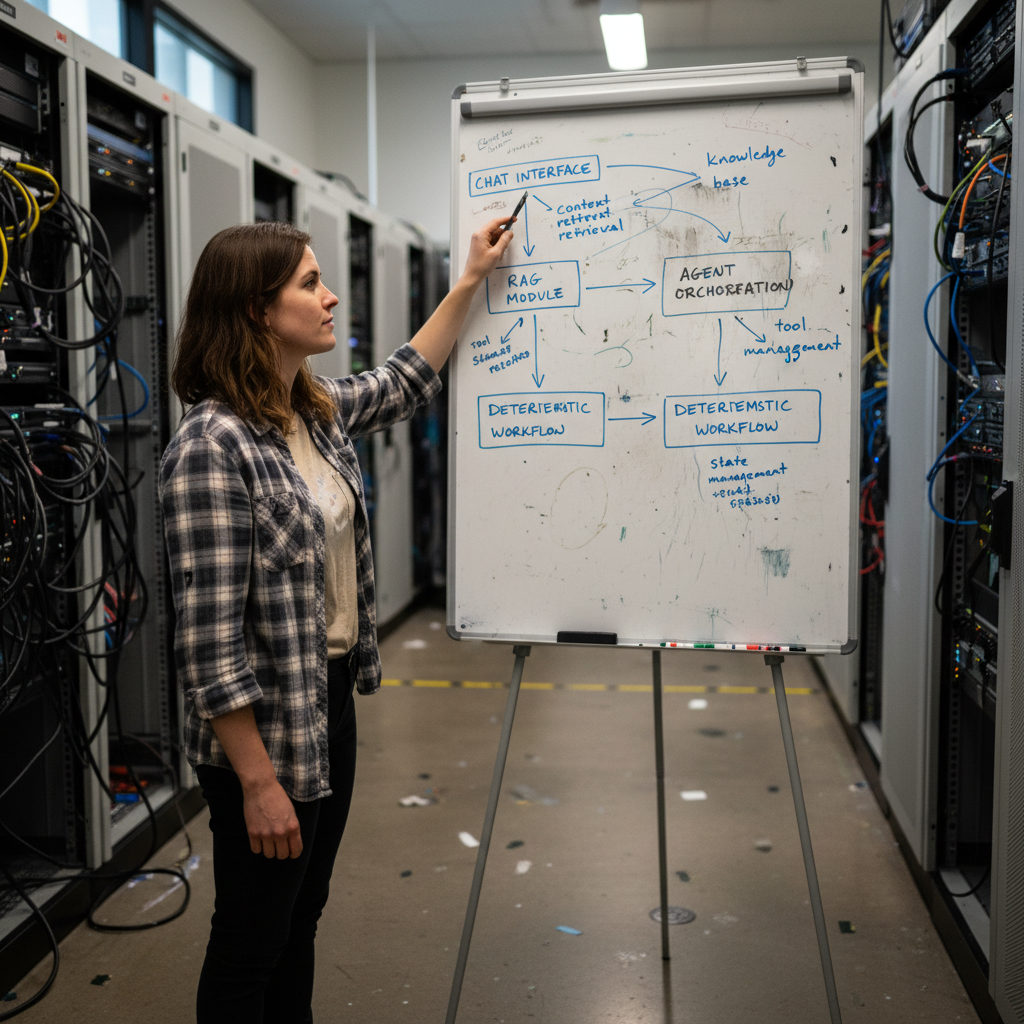
A technical guide for engineering leaders on selecting the right LLM architecture patterns—chat, RAG, agents, and deterministic workflows—balancing innovation with governance and operational safety.
When to use simple chat
Simple chat interfaces serve as the entry point for LLM interactions, particularly in environments where the primary objective is to facilitate information retrieval or provide conversational assistance. These interfaces are particularly effective for internal applications where the need for complex external integrations is minimal.
The operational footprint associated with simple chat patterns is relatively low, making them suitable for rapid prototyping and low-risk internal tools. However, it is crucial for engineering leaders to understand that this pattern does not address scenarios requiring integration with external data sources or complex workflows.
- Best for internal knowledge queries and drafting tasks.
- Minimal operational footprint and low risk profile.
- Does not inherently solve external data integration needs.
When to use RAG
Retrieval-Augmented Generation (RAG) is a preferred architecture for enterprise applications that necessitate access to proprietary or sensitive data. By separating the knowledge base from the model weights, RAG enables organizations to utilize LLMs while safeguarding their data integrity.
Implementing RAG effectively requires meticulous attention to data indexing, retrieval accuracy, and latency management. Engineering teams must develop robust pipelines to ensure that the context retrieved is both relevant and current, making this pattern particularly advantageous for customer support and knowledge management applications.
- Essential for accessing proprietary or sensitive data.
- Decouples knowledge base from model weights.
- Requires robust data indexing and retrieval pipelines.
When to use agents
Agents represent a transition from passive information retrieval to proactive task execution. They are designed to handle multi-step workflows, interact with external systems, and adapt to changing conditions. In enterprise settings, agents are particularly useful for automating complex operational tasks.
However, deploying agents introduces significant governance and safety complexities. Engineering leaders must establish stringent guardrails to mitigate risks associated with unauthorized actions, ensure auditability, and manage the challenges posed by autonomous decision-making.
- Designed for multi-step workflows and external system interaction.
- Introduces complexity regarding governance and safety.
- Requires strict guardrails and auditability.
When to use deterministic workflows
Deterministic workflows offer a structured methodology for AI integration, ensuring that outputs are predictable and verifiable. This pattern is particularly crucial in compliance-heavy environments where adherence to regulatory standards or business rules is mandatory.
The main advantage of deterministic workflows lies in their ability to verify each step of the process, which is vital for high-stakes operations such as financial transactions and legal document processing. Engineering teams must balance the flexibility of AI with the rigidity required for compliance.
- Essential for compliance-heavy environments.
- Ensures predictable and verifiable output.
- Balances AI flexibility with compliance rigidity.
Trade-offs between the patterns
Choosing the appropriate architecture pattern involves balancing innovation with operational safety. While simple chat interfaces provide ease of use, they may lack depth for complex queries. RAG facilitates data access but necessitates a robust infrastructure. Agents offer the potential for automation but come with governance challenges, while deterministic workflows ensure compliance but may limit flexibility.
The decision-making process should be informed by a comprehensive understanding of the operational implications of each pattern, including considerations of latency, cost, data sovereignty, and the ability to monitor and control AI outputs. A thoughtful approach to architecture selection is essential for aligning AI initiatives with organizational goals.
- Balancing innovation with operational safety.
- Evaluating trade-offs based on enterprise context.
- Guided by operational implications and risk tolerance.
Conclusion
The enterprise AI landscape is shaped by the strategic selection of architecture patterns that align with organizational objectives and constraints. Whether leveraging simple chat interfaces, RAG, agents, or deterministic workflows, the focus should be on building systems that are not only technically sound but also operationally robust.
By adopting a structured approach to architecture selection, organizations can navigate the complexities of enterprise AI with confidence. This ensures that AI initiatives are sustainable and effective, ultimately supporting long-term success in an increasingly competitive environment.
- Aligning architecture with organizational goals.
- Prioritizing operational controls and governance.
- Ensuring AI initiatives are operationally robust.
Frequently asked questions
How do I choose between RAG and agents?
Choose RAG when you need to access specific data without autonomous action. Choose agents when you need the AI to perform multi-step tasks and interact with external systems.
What are the main risks of using agents?
The main risks involve unauthorized actions, lack of auditability, and potential for autonomous decision-making errors. Strict guardrails and oversight are required.
Why are deterministic workflows important?
Deterministic workflows ensure predictable and verifiable output, which is critical for compliance-heavy environments and high-stakes operations.
Next step
Book a ThinkNEO session on production-grade AI architecture and operations.